
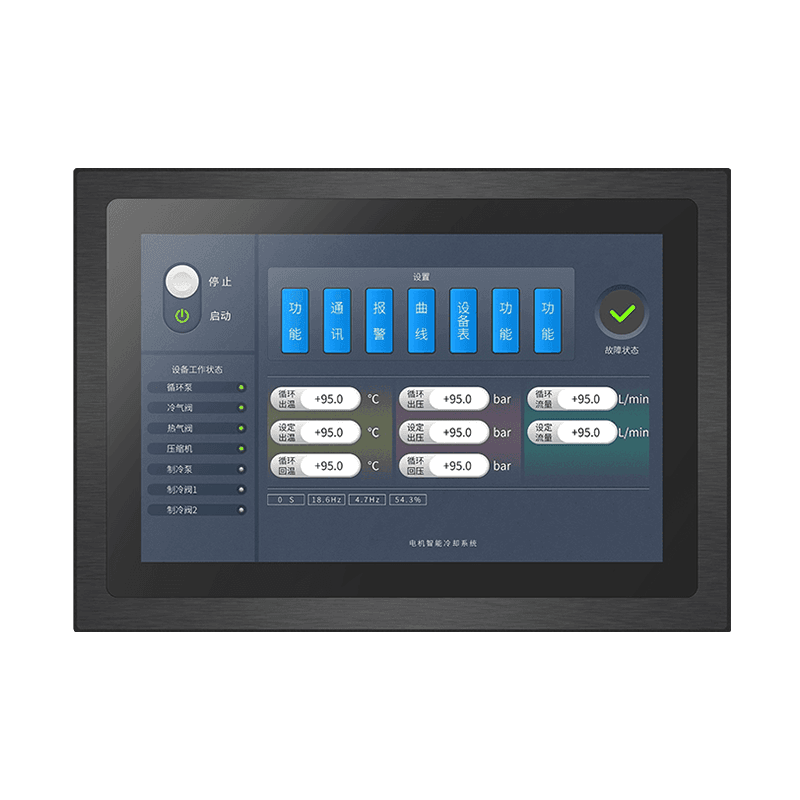
An operator panel that shows numbers is the easy half of the job. Pulling those numbers out of a controller, at the rate the process needs, without loading either end down, is where schedules slip. Most of the delay comes from choices made late: a port nobody confirmed, a protocol the PLC speaks and the panel does not, a gateway that never made it into the budget.
All three are decided by two things: distance and who else needs the data.
Distance decides the physical layer
Start with how far the signal travels and what sits alongside it. RS-232 handles short point-to-point runs inside a single cabinet, and rarely anything crossing a machine. RS-485 signals differentially over a twisted pair, tolerates the electrical noise that drives and contactors produce, and accepts several devices on one bus. Those two properties explain why RS-485 still turns up on new machines from builders who have every other modern option available.
Ethernet changes the calculation once bandwidth or layout matters. Several servo axes, a vision station or traceability logging generate more traffic than a serial link comfortably carries, and switches let you build star topologies instead of a single bus that fails as one unit. The trade-off is that the operator panel now sits on a network the engineering laptop also wants to reach, which is a design decision rather than a bonus.
What the two ends agree to speak
RS-485 defines voltages and timing. Something above it has to define addressing and meaning.
Modbus is the default on serial links, and Modbus TCP wraps the same register model for Ethernet. Its age is both drawback and advantage: support is close to universal, diagnostics stay thin, and there is nothing built in that governs who may write to what.
The industrial Ethernet protocols address that inside defined ecosystems. EtherNet/IP carries CIP and is maintained by ODVA. PROFINET grew out of the Profibus community and is common across European factories. In practice you rarely choose either from a blank sheet, because the decision follows whichever controller family the plant already standardised on.
Above them sit OPC UA, which models data instead of exposing raw addresses, and MQTT, a lightweight publish-subscribe transport aimed at constrained devices and unreliable links. Both tend to appear further up the stack rather than in a direct panel-to-PLC exchange: once data has to cross into a MES or a cloud service, their job begins.
The consequence for your HMI is concrete. A driver is needed for whichever protocol the controller speaks, and there is no universal set. Confirm that with the supplier before ordering. The alternative is discovering it during commissioning.
Where a gateway earns its place
Direct polling between one controller and one screen is fine. It stops scaling when several devices with different dialects have to feed a single dashboard, or when only some of them are reachable from the plant network.
An edge node between them does four things worth paying for. It polls serial and Ethernet devices on the machine side and republishes everything as one interface. Across protocols it translates, sparing the display a driver for every PLC vintage in the machine. Local buffering covers the uplink that drops: readings are retained and forwarded once the link is back instead of disappearing. And concentrating every OT-to-IT crossing into one box leaves something you can actually secure and audit, rather than a dozen implicit connections nobody mapped.
Failures that are cheap to design out
Field problems are usually dull. On RS-485, both ends of the trunk need termination, polarity conventions differ between vendors, and a bus wired as a star rather than a daisy chain behaves perfectly on the bench then misbehaves beside a running drive. On Modbus, two devices sharing a slave address produce symptoms that read like random corruption.
Polling rate causes the second recurring fault. Ask registers faster than a small PLC's communication budget allows and the controller takes the load, not the screen, so what you see is a PLC occasionally overrunning its cycle while the display looks perfectly healthy. Begin conservatively and measure.
Network layout deserves equal caution. Operator displays, historians and motion control sharing one flat network introduce jitter that nobody will be able to trace later. Separate VLANs and a defined route for anything leaving the line cost a day of engineering and save weeks of it.
Mapping it back onto hardware
With topology settled, the physical choice gets simpler.
A cell-level operator station next to a machine usually means a defined cut-out in a door. The G S1 10.1" uses a CNC aluminium frame for front-embedded mounting, ships as IXG101S1-RK3568, and belongs to the G series we position for machine and instrument control. A wider supervisory view over several cells suits something larger such as the P X1 15.6", rear-embedded aluminium, whose published models include IXP156X1-RK3568 with a Rockchip RK3568 quad-core A55 running at 2.0 GHz, alongside RK3288 and Allwinner A133P options. The P X2 21.5" carries the same approach into a front-embedded frame.
Where the panel has to sit behind your own fascia, the shellless S series drops the housing entirely. The S 10.1" exists as IXS101-A133P variants that differ by IPS or TN panel, and the difference shows in viewing angle rather than resolution. The F IC 7" integrates a die-cast aluminium structure for external embedded mounting in places where plastic has no business being the outer surface.
Protocol handling belongs a tier up. The B H1 10.1" sits in the B series we build for industrial edge work, which is where gateway duties normally land.
One caveat covers the whole catalogue. Interfaces, available drivers and protocol licences follow the carrier board and the Android build, so all three get confirmed per model before an order. Identical housings take different boards, and assuming otherwise is how equipment arrives unable to talk to anything.
What to have ready before asking for a quote
Controller make and model. Protocols licensed on that controller. The tag list. Update rate actually required, not the one nobody will ever read. How machines and the office network connect. Whether the display talks to the controller directly or through something in between.
Those answer most hardware questions and establish whether a gateway belongs in the bill of materials at all.
Bringing the panel and the controller together
AOYU builds touch panel PCs and industrial displays across six series, S through B, covering these installation styles from shellless cabinet mounting to embedded-aluminium operator stations, with OEM and ODM options when the board or housing needs to change.
Send us the controller list and the network diagram through our inquiry form, or message us on WhatsApp. We will tell you which series and board fits, and where the integration needs a gateway rather than another screen.
Ready to start your HMI project?
Our engineers help you choose the right HMI hardware and software for your project.