
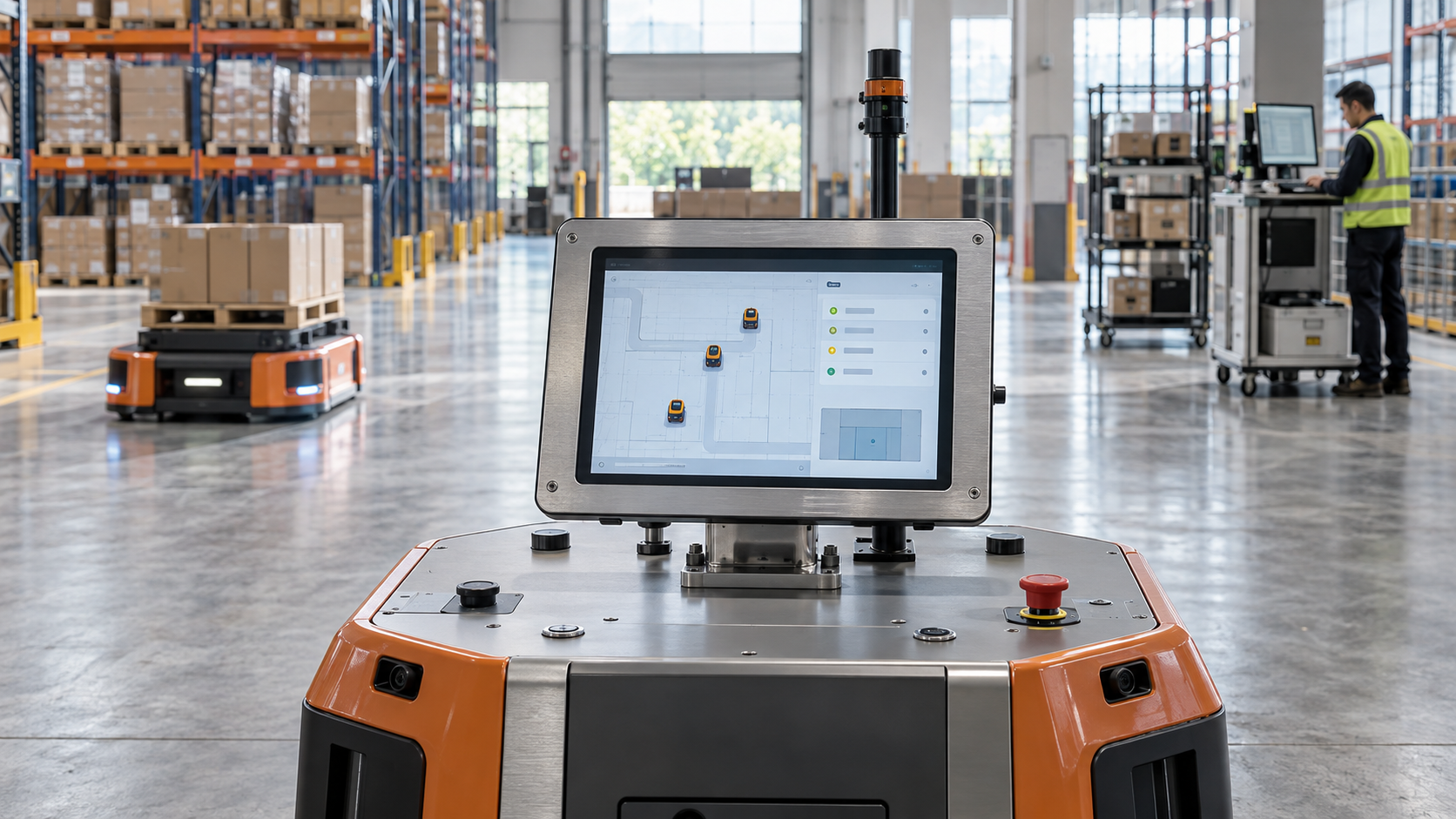
A panel PC bolted to a wall in a control room leads an easy life. Room temperature, clean mains power, an Ethernet cable nobody touches. Take the same unit, screw it onto an automated guided vehicle that crosses a warehouse floor eleven hours a day, and it turns into a different product: same part number, different failure modes.
Mobile installations are where a lot of industrial HMI projects meet their surprises. The specification looked right on paper. What went wrong happened at a connector, or at the instant the battery dipped, or during the two seconds the vehicle passed behind a steel rack and lost its wireless link.
Vibration arrives before anything else
A forklift crossing a floor joint makes a short, sharp shock. Multiply that by a few thousand cycles a day and the weak points are seldom the LCD itself. They are the board-to-board connectors, the storage module seating, the screw terminals on the power input, and the flat cables between the touch sensor and the controller board.
For anything that rolls, ask for locking connectors and a storage design that does not depend on a removable module staying put. Fanless construction helps twice over — no moving part to wear out, and no air path pulling grinding dust into the housing. A rigid frame is worth more than it looks on a datasheet. The F IC 7" panel uses a single die-cast aluminium body instead of a sheet-metal assembly, so the housing does not flex when the vehicle hits a seam.
Vehicle power is not clean power
An AGV runs off a battery through a DC-DC converter, and the converter shares that battery with traction motors. When the motors pull hard, the rail sags. When regenerative braking kicks in, it overshoots. A panel that would have been perfectly happy on a 24 V supply in a lab can restart itself here, and every unplanned restart is a chance to corrupt the filesystem.
Wide input range is the obvious ask, but it is not the whole story. Ask what the board does in the last 10 milliseconds before the rail collapses: whether there is hold-up capacity, whether the OS is on a read-only partition, and whether the unit comes back to the same application screen instead of a desktop. We went into the electrical side in detail in Heat, cold and dirty power.
The network will drop, plan for it
Warehouses are hostile to radio. Racking is steel, the goods move, and a vehicle that crosses three access points during one trip will roam several times. Roaming handovers of 200 to 500 milliseconds are normal, and an HMI that treats every disconnection as a fatal error will show a spinning icon at exactly the moment an operator needs it.
Two things solve most of this. Put the antenna where the metal is not — external antenna mounts cost little and make a measurable difference on a steel vehicle. And design the application to keep working offline: queue the transactions locally, reconcile when the link returns. The hardware decision behind the second point is storage that survives sudden power loss, which is the same decision you already made for the vehicle supply.
Inspection carts and mobile workstations
The second common home for a mobile panel is a cart. In a process plant or a large assembly line, an operator pushes a workstation along a route, reads the schedule, scans a part, records a result, moves on. The usage pattern is different from an AGV: fewer shocks, more human interaction.
Here the ergonomics decide more than the electronics. A screen mounted flat on a cart top is read from 30 cm away while standing, so the tilt angle matters more than the brightness. Gloves matter. So does the height of the bezel, because a raised edge keeps the panel alive when the cart is pushed into a bench. The P M1 10.1" and its 7-inch sibling are built for front-embedded and wall-mounted installation, which is usually what a cart panel needs. Where the cart carries a scanner or a printer, count the serial ports before you order — a USB hub strapped to the underside of a cart is a part that will fail.
Field service and commissioning kit
Engineers who commission machinery on site carry their own interface. The panel goes into a case, travels in a van, gets powered from an inverter or a battery pack, and is expected to work in a client's factory the same afternoon. Weight and mounting become the constraints: a 21.5-inch panel is excellent for a commissioning stand and useless in a flight case.
Sunlight readability is the specification that gets missed here. A hall with a roof lantern, or a door standing open in summer, produces more glare than most indoor ratings anticipate, and an anti-glare surface treatment changes the reading experience at no cost in other areas. Pair that with a sensible ingress rating for the environment — we covered the IP codes in a separate article — and the panel survives the trip as well as the job.
What to settle before you order
Most rework on mobile projects traces back to four questions that were never written down.
- Mounting. Front-embedded, rear-embedded, or a bracket? It fixes the cut-out drawing, the bezel profile and the sealing method, and it is the hardest thing to change later.
- Supply. Nominal voltage, the real range including dips and regenerative overshoot, and what the panel must do when the rail disappears.
- Radio. Where the antenna physically sits, whether the application tolerates a roaming gap, and how transactions are queued while offline.
- Touch. Bare finger, latex glove, or a thick winter glove. The answer decides the sensor technology, and we compared the two options in Capacitive vs resistive touch.
Add the interfaces you actually need — RS-232 or RS-485 for older drives, CAN for vehicle buses, GPIO for an interlock — and the list is complete enough to send to a supplier. Where a vehicle bus or an older drive is in the loop, a panel with isolated serial ports already on board — the AY-TJ101-H carries dual isolated RS-485 — removes a converter box from the wiring plan. If the volumes justify a custom front panel or a different I/O layout, the OEM/ODM route is worth comparing against an off-the-shelf unit before you commit.
Where to start
Our B series covers the industrial edge and IoT side at 10.1 inches, with plastic-frame and CNC aluminium front-embedded variants. For wall-mounted or front-embedded installation on a cart, the P M1 7" and 10.1" are the usual starting point, and the P X1 15.6" suits a fixed dispatch or commissioning stand where operators stand back from the screen.
If you are specifying a panel for a vehicle, a cart or a field kit, send us the mounting drawing and the supply conditions. We will tell you what we would change, and what we would leave alone. Start here.
If a vehicle, a cart or a field kit is on your roadmap, the fastest start is a shortlist against your mounting drawing and supply range. Send an inquiry, or see where these panels are used in industrial automation.
Frequently asked questions
What screen size works on an AGV or inspection cart?
7 to 10.1 inches covers most vehicle and cart installations — a P M1 7" front-embedded unit is a common cart choice, and 10.1-inch models when operators need more map or list on screen. Panels above 15 inches belong on fixed dispatch or commissioning stands.
Can a panel PC survive battery dips and regenerative braking?
Specify the real input range, including dips and overshoot, rather than nominal voltage, and confirm hold-up behaviour plus a read-only root filesystem so a brownout cannot corrupt storage.
Which touch technology fits glove use on vehicles?
Resistive sensors register latex and winter gloves; capacitive gives a clearer image and multi-touch for bare fingers. The trade-off is described in Capacitive vs resistive touch for industrial HMI.
Does the HMI keep working when the Wi-Fi drops?
The application should queue transactions locally and reconcile after the link returns. On the hardware side, mount the antenna clear of steel and confirm the storage survives sudden power loss.
Related products
Explore our HMI panels
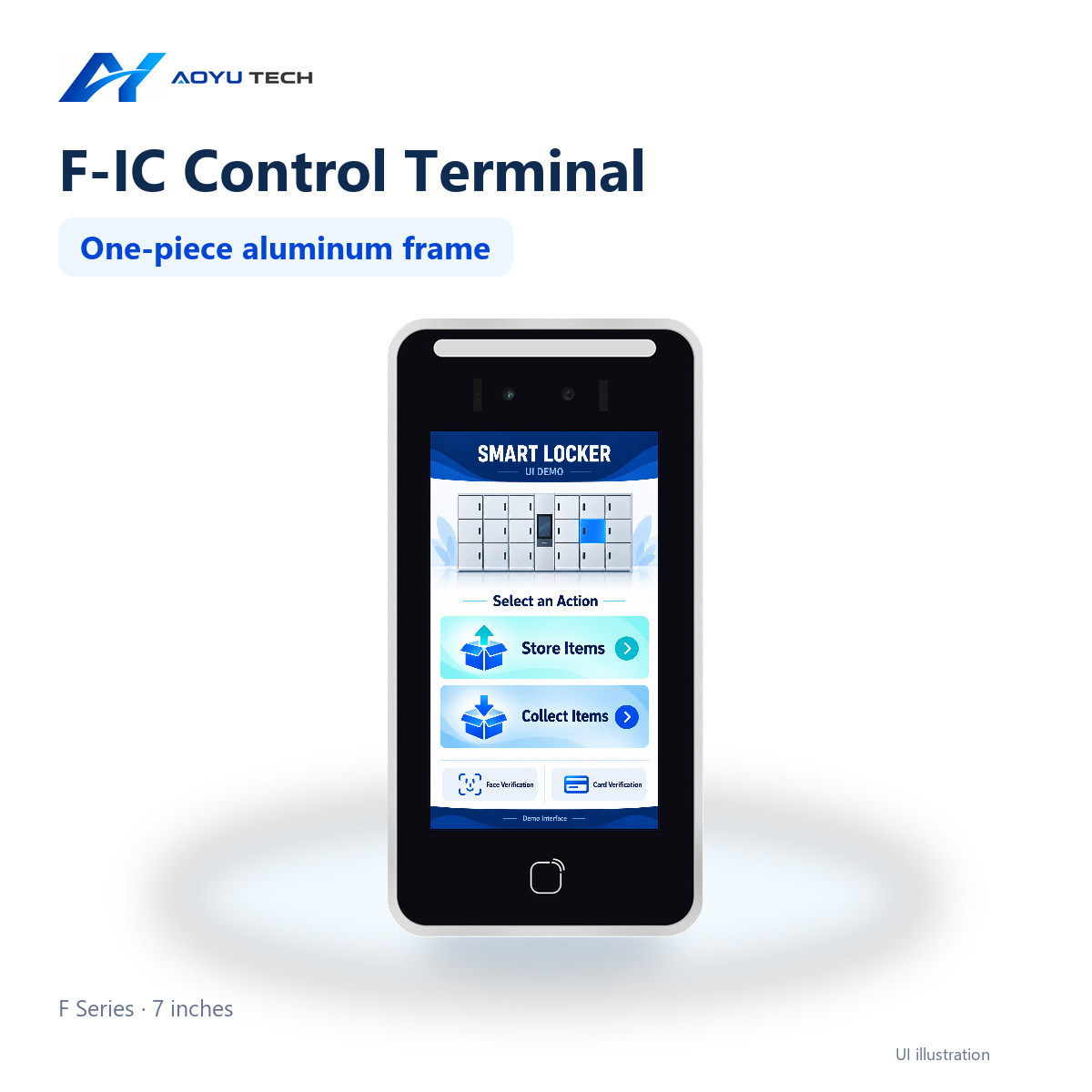
F-IC-7 7-inch HMI Panel
Material: Die-cast aluminum alloy. Mounting methods: Exterior inset mounting. Front panel …
View product →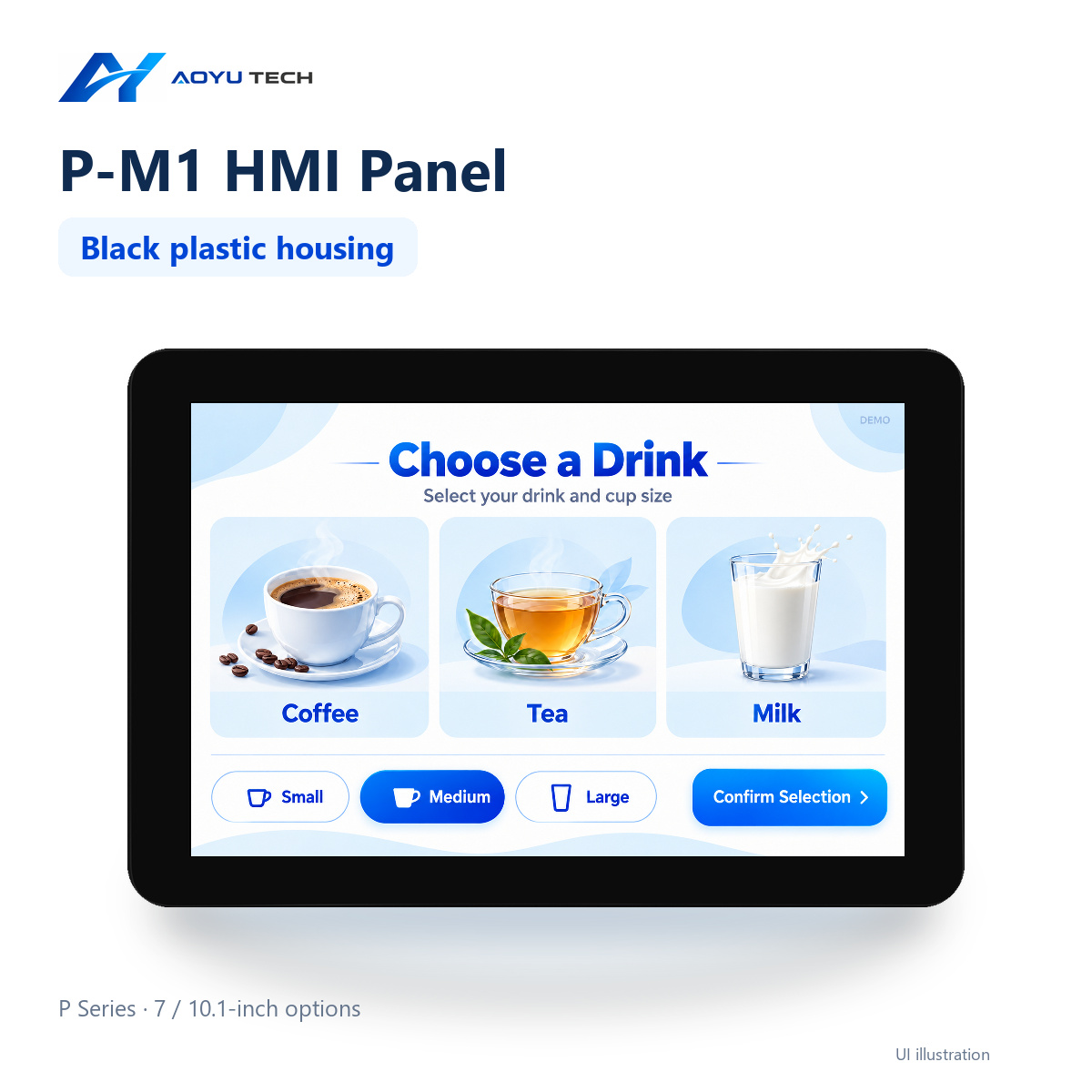
P-M1-101 10.1-inch HMI Panel
Display size: 10.1 inches. Brightness: standard: 500; optional: 1000 cd/m². Viewing angle:…
View product →
AY-TJ101-H 10.1-inch RK3568 ARM Touch Panel PC
An ARM interface for connected equipment AY-TJ101-H combines a quad-core RK3568 Cortex-A55…
View product →Ready to start your HMI project?
Our engineers help you choose the right HMI hardware and software for your project.