
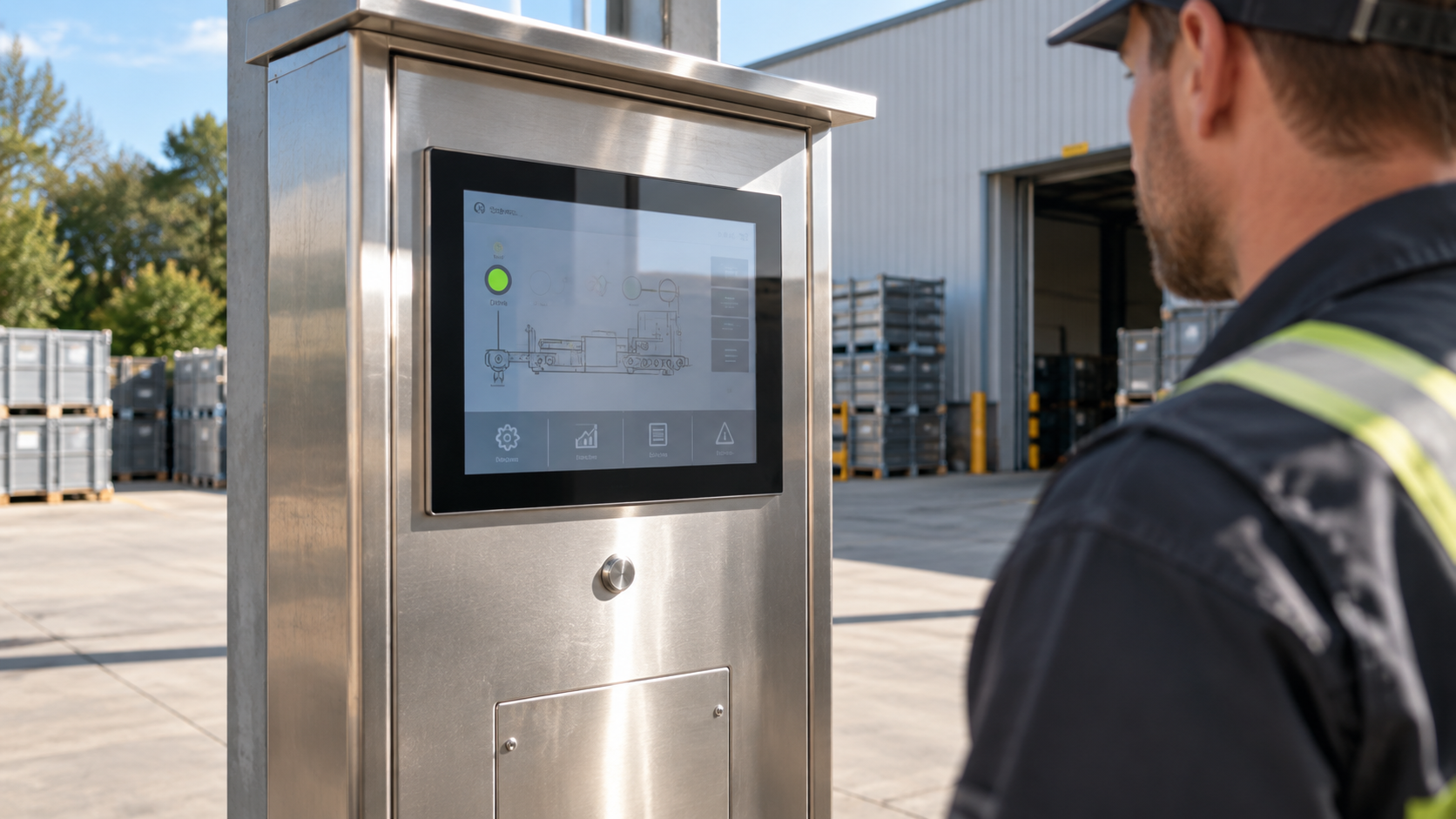
A datasheet that says 1,000 nits and "sunlight readable" can still give you a panel that turns grey at noon. Projects usually discover this after the kiosk is bolted down and the site has started complaining. The backlight is rarely the culprit. Reflected light is.
Everything you see on a screen is the sum of two things: the light the panel emits and the light bouncing off its front surface. Contrast is what your eye reads, and reflection raises the dark end of that range. Push the black level up far enough and the text loses its edge, no matter how many nits are behind it.
How much light comes back at you
Reflected luminance is approximately ambient illuminance multiplied by surface reflectance, divided by pi. Straightforward, and it gives numbers worth seeing before anyone argues about brightness tiers.
Direct sun on a clear day puts somewhere between 30,000 and 100,000 lux on a vertical surface. Take 100,000 lux and a bare cover glass at 4% reflectance and the reflection alone comes to roughly 1,270 cd/m². A 1,000-nit panel sitting in that light is competing with more reflected light than it produces. Overcast daylight runs closer to 1,000 to 25,000 lux, and an indoor office around 300 to 500, which is why the same panel behaves perfectly well on a factory wall and badly at a gate terminal.
Three surfaces, not one
An air-gap assembly reflects from more places than most buyers expect. There is the outer face of the cover glass, the inner face of that glass where it meets the trapped air, and the top surface of the LCD itself. Air sits at a refractive index near 1.0 and glass around 1.5, and each crossing sends roughly 4% of the light back. Add a touch sensor and there may be a fourth.
Published totals for unbonded stacks land somewhere between 8% and 12%. That is the number that matters when you compare options, not the brightness of the backlight in isolation.
What bonding actually removes
Optical bonding fills the gap with an optically clear adhesive, either OCA film or liquid OCR, index-matched to the glass. The internal interfaces stop existing as optical boundaries. Light travels through cover glass, adhesive and panel as though it were one block, and only the outer surface still reflects.
Put an anti-reflective coating on that outer surface and total reflectance below 1% becomes a realistic target, with some suppliers quoting 0.5% or lower. Against an air-gap stack at 10%, that is an order-of-magnitude change in what washes over the image.
Three side effects come with it, and they are often the reason the purchase gets approved. A sealed stack cannot fog internally, which removes the condensation failures that show up when a cold panel meets humid air. The adhesive layer distributes impact across the whole panel instead of letting the glass flex into a void, so shock resistance improves. And parallax disappears, so a fingertip lands where the icon appears.
Heat cuts both ways. Solid adhesive conducts better than trapped air, so backlight heat moves towards the front glass. It is still generated inside a sealed enclosure, and that is the constraint once brightness climbs.
AR, AG, and what each one costs you
AR and AG get confused constantly, and they behave differently.
AR is a thin-film coating built on interference. It cancels reflected light at the wavelengths it was tuned for and leaves the image sharp. The trade-off is that it lives on the outer surface, where abrasion and aggressive cleaning eventually get to it.
AG is a mechanical etch that turns specular reflection into diffuse scatter. It kills the mirror image of the sun and the operator standing behind it. It also adds haze, so fine text on a dense HMI screen loses crispness. For a screen showing large status blocks at arm's length, that is a good trade. For a 7-inch panel showing nine-point parameter text, it usually is not.
Brightness buys less than you think
Raising backlight output is the other lever, and it is not free. Driving LEDs harder costs power roughly in proportion to the extra light, all of which ends up as heat, and LED lifetime shortens as junction temperature rises. A 1,500-nit panel in a sealed cabinet with no airflow needs a thermal plan, not just a bigger power supply.
Two things are worth checking on any quote, and both appear in the list below. The dimming one is the easier to overlook: a panel bright enough for midday is unpleasant at 2 a.m., and an ambient light sensor costs very little.
Where the money is worth spending
- Indoor, controlled light. Control rooms, assembly lines, hotel corridors. Standard brightness, no bonding. Spend the budget elsewhere.
- Sheltered outdoor. Loading docks, forecourts under a canopy, warehouse gates. Typically 800 to 1,200 nits with AG or a light AR treatment. Bonding is optional and often justified by humidity rather than glare.
- Fully exposed. EV chargers in open lots, agricultural machinery, marine decks, desert sites. High brightness, bonding and AR together, plus a thermal review. Skipping the bonding here is the expensive mistake.
- Cold chain and wash-down areas. Bonding for sealing first, brightness second. Internal fogging is a bigger failure mode than glare.
Questions to put to your supplier
- Is brightness quoted for the bare panel or measured at the front of the assembled stack?
- What is the total reflectance of the finished assembly, and is there a test report behind the figure?
- OCA or OCR, and how many hours of UV exposure has the adhesive been tested for?
- How is a bonded unit repaired or replaced under warranty? A bonded stack that fails at final test generally cannot be re-separated the way an air-gap frame can.
- Does the touch sensor sit inside the bonded stack, and does the cover glass thickness change the touch tuning?
- What dimming range does the driver support, and is an ambient light sensor available?
Suppliers with clean answers give them quickly.
Where this lands on our hardware
Brightness level, AR or AG treatment, and whether a stack gets bonded are configured per project rather than fixed across a catalogue, so the numbers are confirmed during quoting rather than guessed from a product page. What is fixed is the mechanical side, and that is usually where the decision starts.
For a large outdoor kiosk face, our P X2 21.5" front-embedded panel gives you an aluminium frame loaded from the front, with the gasket and sealing face visible for inspection. The P X1 15.6" is loaded from behind, which leaves a cleaner visible surface and moves the sealing interface inside the cabinet. Where the panel sits exposed on a machine or a charging post, the F IC 7" die-cast panel carries its own aluminium frame and mounts externally. For 10.1-inch formats, the G H1 10.1" and B H1 10.1" both use front-embedded plastic frames.
If you have a site in front of you, tell us the mounting orientation, the shade conditions and the operating hours. We will say whether bonding changes anything for that install or whether the budget is better spent on the backlight. Start at our inquiry page.
Related products
Explore our HMI panels
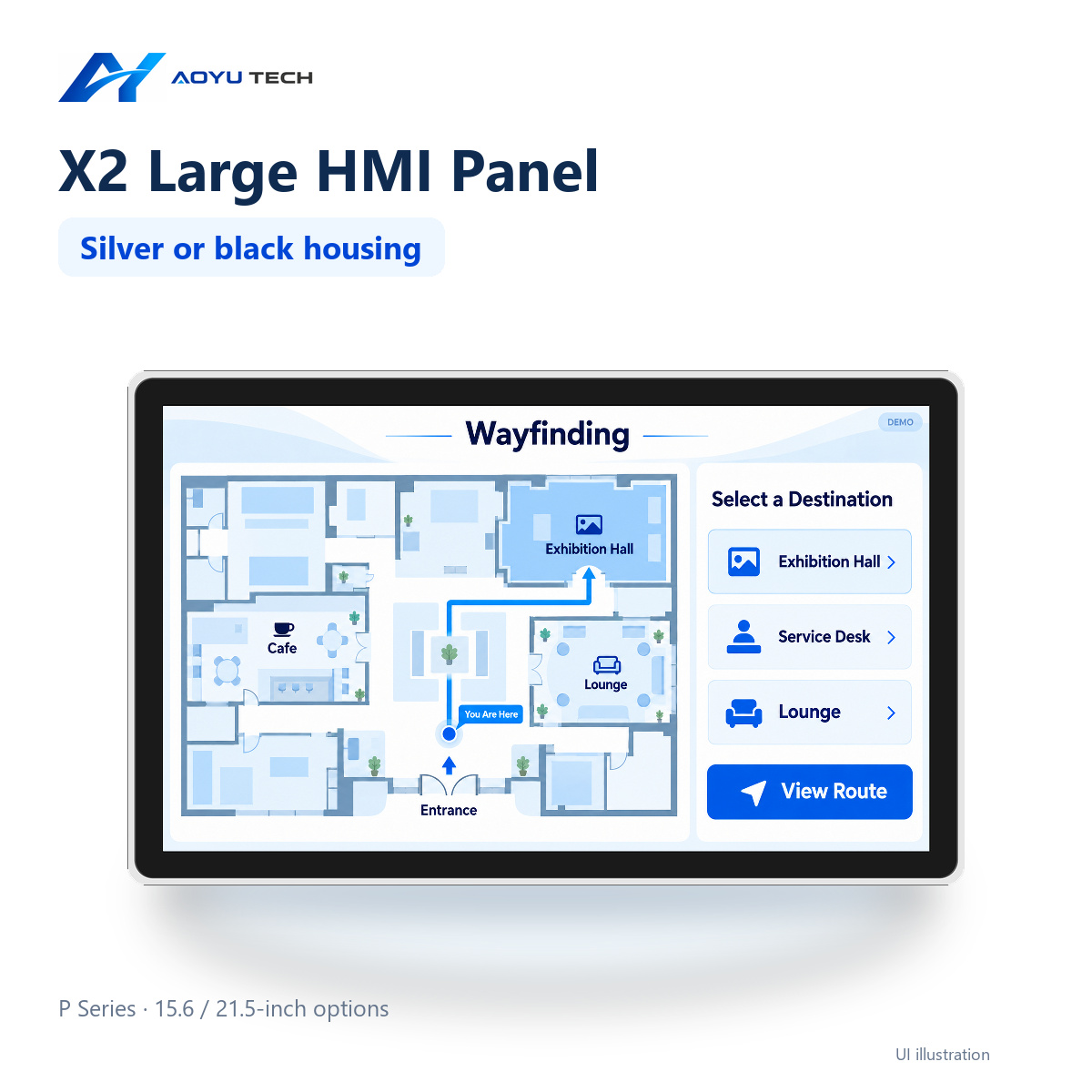
P-X2-215 21.5-inch HMI Panel
Display size: 21.5 inches. Resolution: 1920 × 1080 px. Brightness: standard: 250; optional…
View product →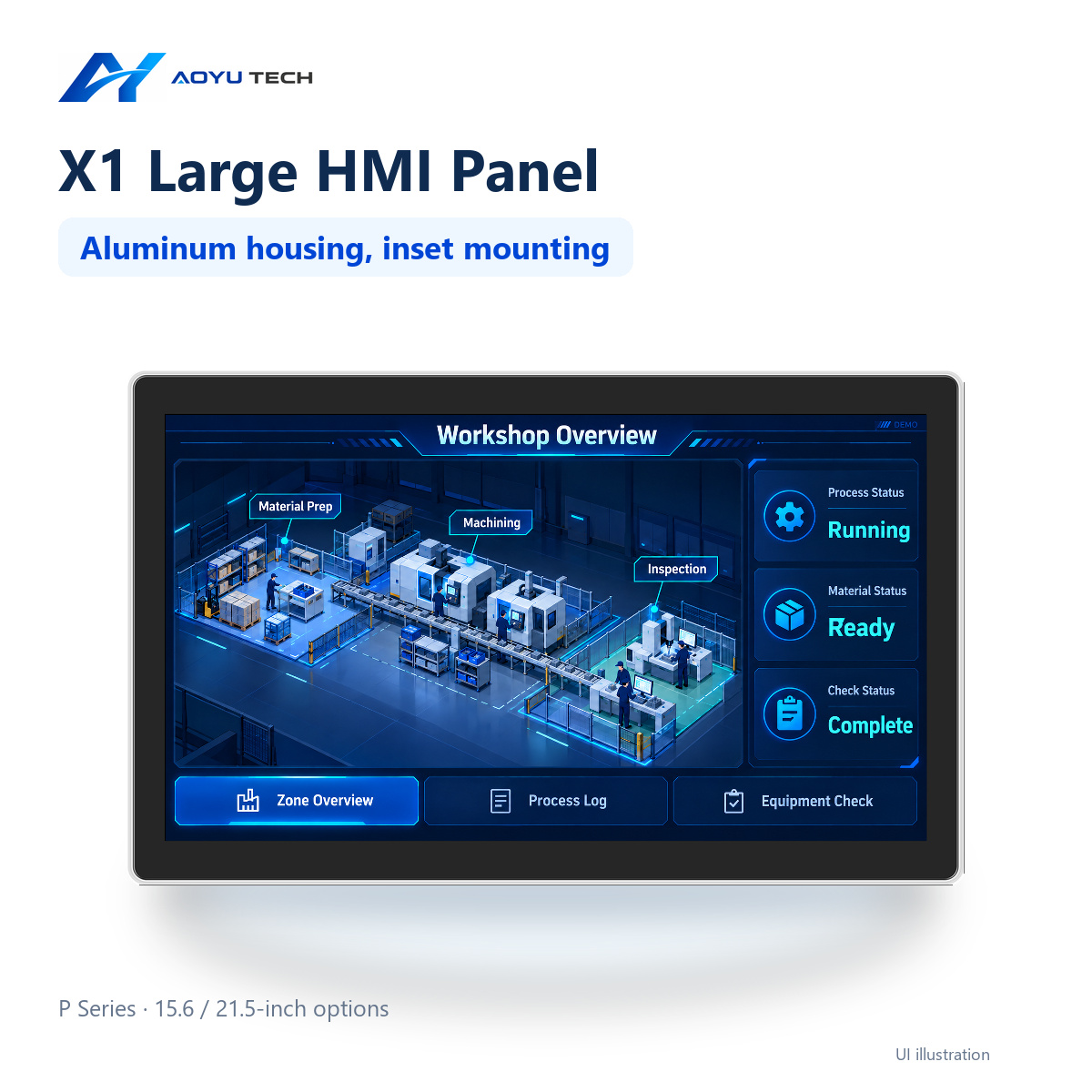
P-X1-156 15.6-inch HMI Panel
Display size: 15.6 inches. Resolution: 1920 × 1080 px. Brightness: standard: 250; optional…
View product →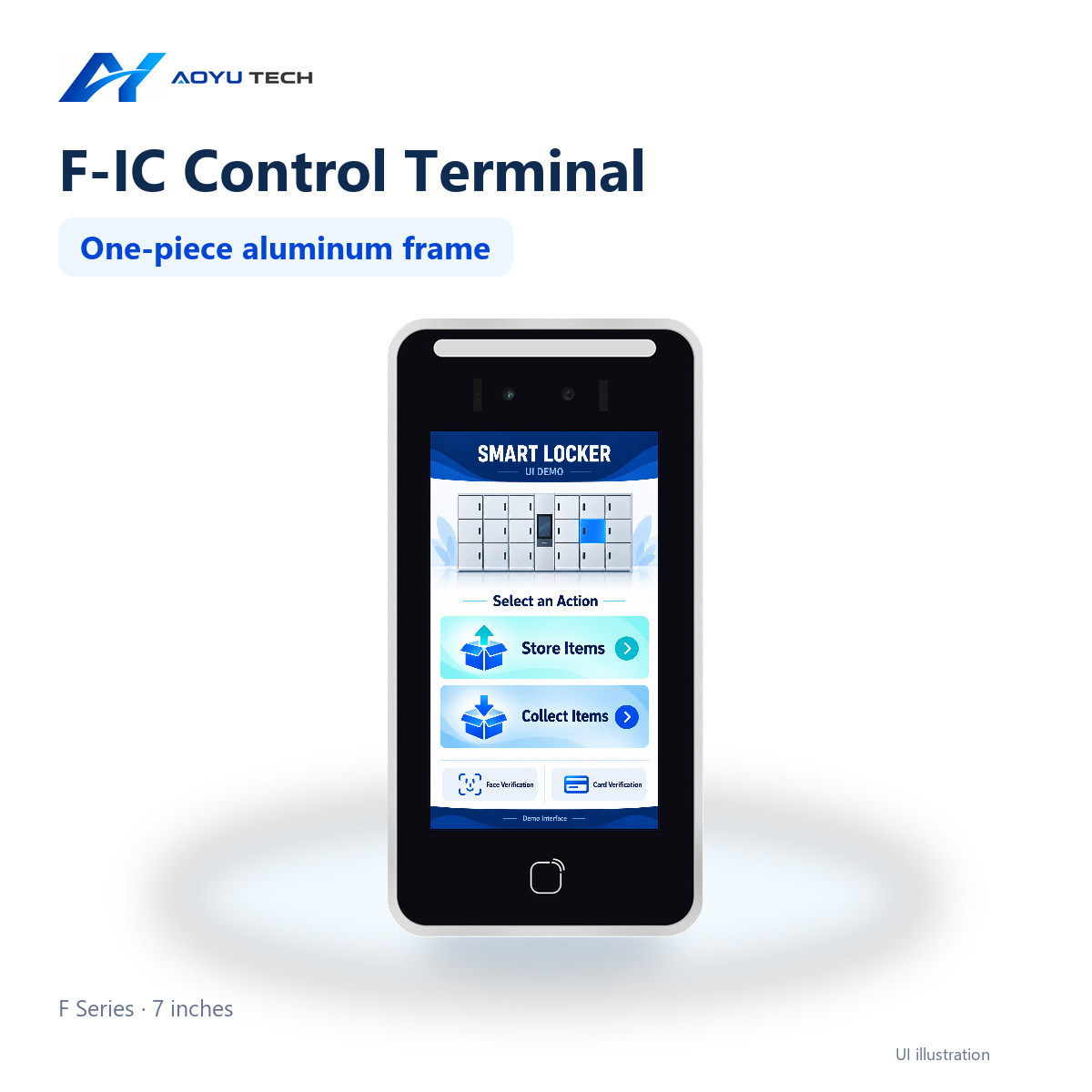
F-IC-7 7-inch HMI Panel
Material: Die-cast aluminum alloy. Mounting methods: Exterior inset mounting. Front panel …
View product →Ready to start your HMI project?
Our engineers help you choose the right HMI hardware and software for your project.