
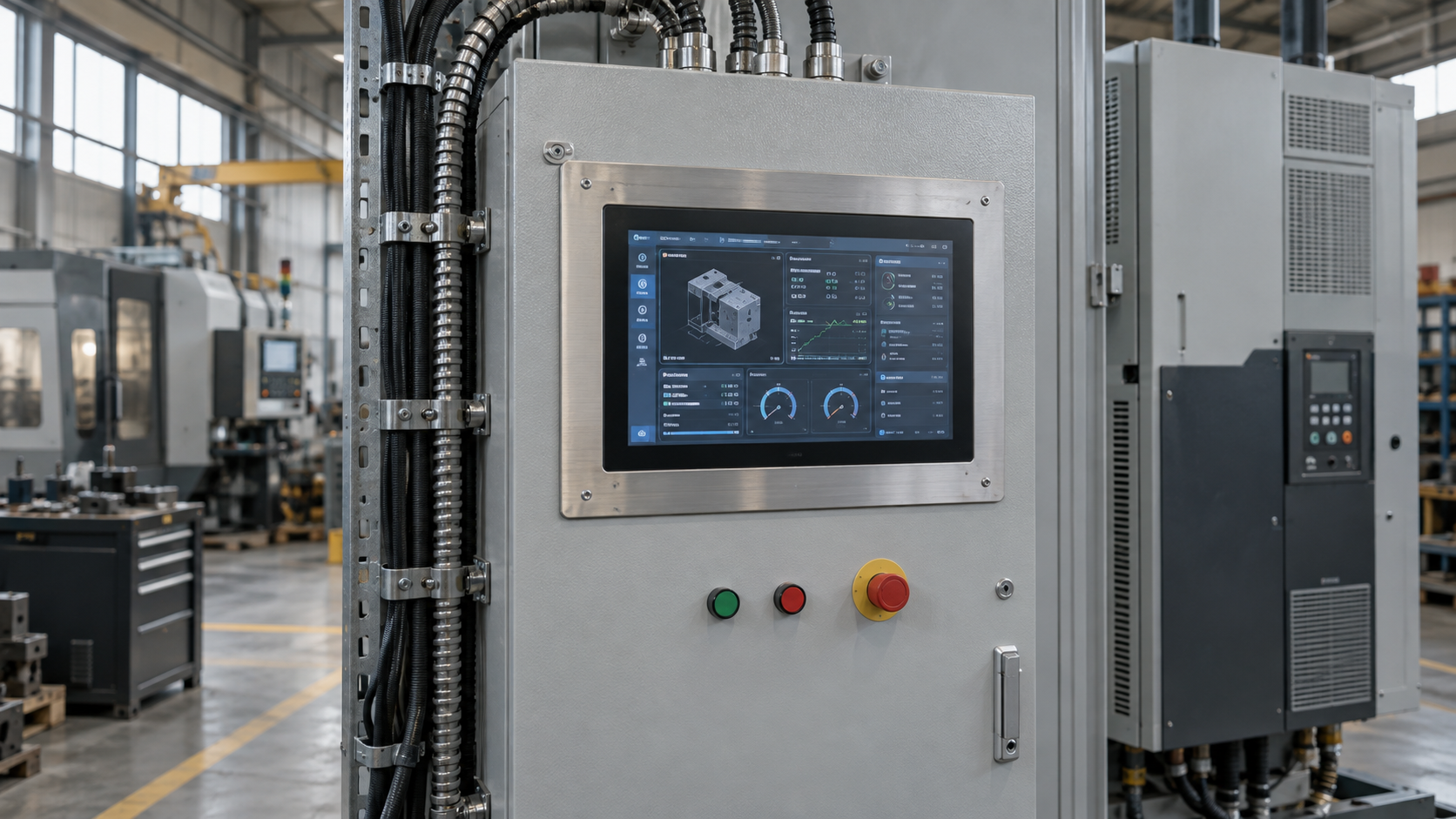
Most HMI panels get specified like a computer. Processor first, RAM second, screen size third. Then the unit ships to a plant where the night shift works in single digits and the 24 V rail dips every time a contactor opens. Three months in, the call arrives: frozen screen, black panel after a power cut, touch gone since the last hour of the shift.
Processor and RAM almost never explain those failures. The environmental and electrical columns of a specification do, and they are the columns most often left blank.
A temperature rating is three numbers
Commercial tablets and office monitors assume a room: roughly 0 °C to 40 °C, non-condensing, air-conditioned. An outdoor enclosure in a Nordic January or the inside of a sealed steel cabinet on a Guangdong afternoon both sit outside that assumption.
Read all three numbers where they exist. Operating temperature is the band the unit is built to run in continuously. Storage temperature stretches further, but describes a powered-off device: the panel survives it, nobody promises it computes there. The third figure is quoted least often, the permitted rate of temperature change, and it governs anything carried from a warm room into a cold hall.
Cold reaches the display first. Liquid crystal thickens as it nears its clearing point, so pixel transitions slow and moving images smear, and backlight drivers that start cleanly at room temperature struggle when cold. Capacitive controllers carry a separate problem: they compare finger capacitance against a baseline they re-measure continuously, and when that baseline drifts faster than firmware can recalibrate, the panel ignores real touches or invents ones that are not there.
Heat works on the electronics instead. An old rule of thumb in power electronics holds that aluminium electrolytic capacitor life roughly halves for every 10 °C the internals run hotter. That is an estimator, not a promise, but the conclusion survives: ten degrees pulled off internal temperature with better heat sinking buys real service years on equipment built to run continuously.
Cycling needs its own line of thought. The materials inside a housing expand at different rates, so repeated hot-cold trips fatigue solder joints, board-to-board connectors and the mounting ears on a die-cast frame. Passing a steady-state soak at 60 °C is not the same test as 500 nights on a machine that runs until noon and cools until morning.
What "24 V DC" actually means on site
That label is nominal, not the waveform that arrives. The same rail feeding a panel usually drives contactors, solenoid valves and relay coils too. Every inductive load that opens throws a spike back onto the supply, every motor that starts pulls the rail down, and cable loss adds its share. Twenty or thirty metres of 24 V is ordinary across a conveyor line or tank farm, and worse during inrush.
A 9 V to 36 V DC input range, common on industrial panel PCs, lets one board serve 12 V mobile equipment and 24 V fixed installations, and ride out the dips between them. What protects the board is the layer above: reverse-polarity protection so a swapped terminal costs nothing, input transient suppression, and clean sequencing so the system comes back predictably from an undervoltage event rather than hanging mid-boot.
Automatic power-on belongs on the checklist too. Plants lose supply, and they switch panels off at night. If recovery needs somebody to walk over and press a button, uptime depends on somebody being there. A watchdog timer covers the neighbouring fault, software locked while power never cycled.
PoE tidies up wiring for door entry panels, self-service kiosks and warehouse aisles. Three items are worth checking before you commit: available power per port against the panel draw including peripherals, the 100 m Ethernet limit, and whether the switch shares its budget with cameras and wireless access points. Brownouts that appear only after twelve other ports come alive are a familiar field complaint.
Fanless means the housing is the heat sink
Very little inside an HMI should be fan-cooled. A fan is a moving part, it inhales the dust that made you choose an industrial panel, and its filter becomes a maintenance task somebody forgets. Fanless designs pass heat out by conduction into whatever surrounds them, which makes mechanical construction part of the thermal design.
A one-piece die-cast aluminium chassis wrapped around the board spreads heat: energy moves out of the electronics into metal and leaves through the whole outer surface. A CNC-machined aluminium front frame does comparable work on the display side. Within the AOYU TECH line-up, the F IC 7" sits on an integrated aluminium die-cast frame and the G S1 10.1" on a CNC aluminium front frame.
The no-shell S Series reverses that arrangement. The S 10.1" embeds into your own cabinet or machine housing, handing the cooling job to your enclosure. That works when the mounting face is flat, metal against metal, with generous contact area. Difficulty starts when "embedded" ends up meaning buried in a sealed plastic box with no air path. Orientation follows the same logic: most of the body of a rear-embedded P X1 15.6" stays inside the cabinet, so whatever air movement exists back there decides how much heat genuinely escapes.
Six questions to settle before you order
- What is the real extreme rather than the average: the coldest start-up at 6 a.m. in February, and the hottest afternoon inside a closed cabinet?
- Does the panel share its supply with contactors, motors or solenoid valves, and how long is the cable run?
- Is this panel running 24/7, one shift, or intermittently? Steady heat and daily cycling fail in different places.
- After an unplanned power cut, must it return with nobody touching it, and how far into boot did the last stop happen?
- Can condensation form, moving between cold storage and a warm hall, or on a humid floor carrying chilled water lines?
- Who owns heat removal in the finished machine: the panel chassis, your enclosure, or nobody in particular?
Where our ranges sit, and the numbers we will not guess
AOYU TECH builds across six families: open-frame S and C Series for embedding into your housing, P Series for commercial and interactive installations, M Series for cost-sensitive IoT rollouts, G Series for machine control cabinets, B Series for edge computing, and die-cast F Series for heavier duty. All are fanless and conduction-cooled, all support OEM and ODM work, where thermal and electrical targets get set against your machine rather than a datasheet average.
We will not quote a temperature figure here. Each model carries its own environmental ratings and power input range, tied to a specific bill of materials tested a specific way. Tell us where the panel has to live and we will confirm the ratings applying to the model you are weighing up, and flag those that fall short, which moves faster than discovering it in month three.
The full range by series and size is on the products page. If you are specifying against a known environment, send the conditions through our inquiry form or contact us on WhatsApp, and an engineer will confirm per-model ratings before you commit to a build.
Related products
Explore our HMI panels
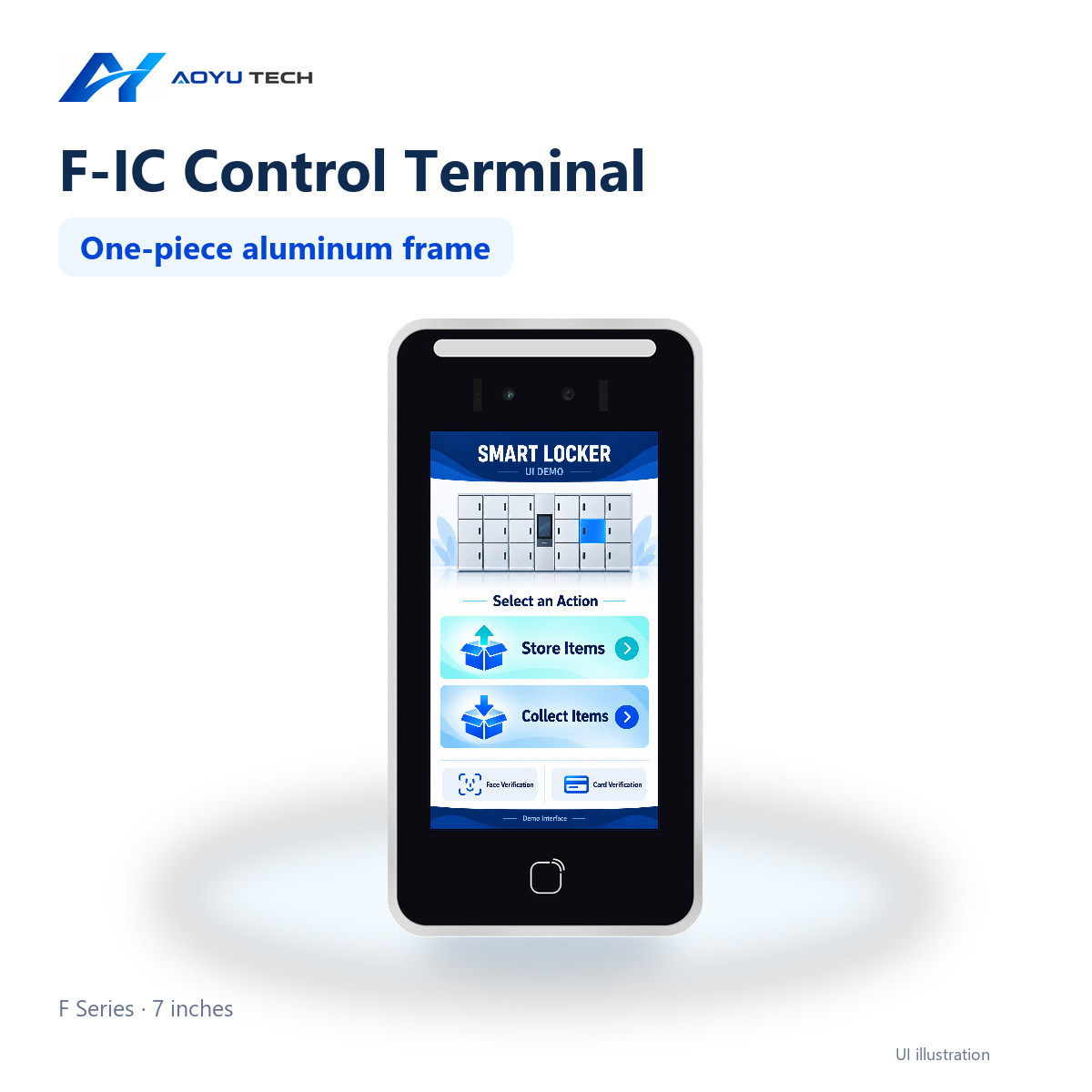
F-IC-7 7-inch HMI Panel
Material: Die-cast aluminum alloy. Mounting methods: Exterior inset mounting. Front panel …
View product →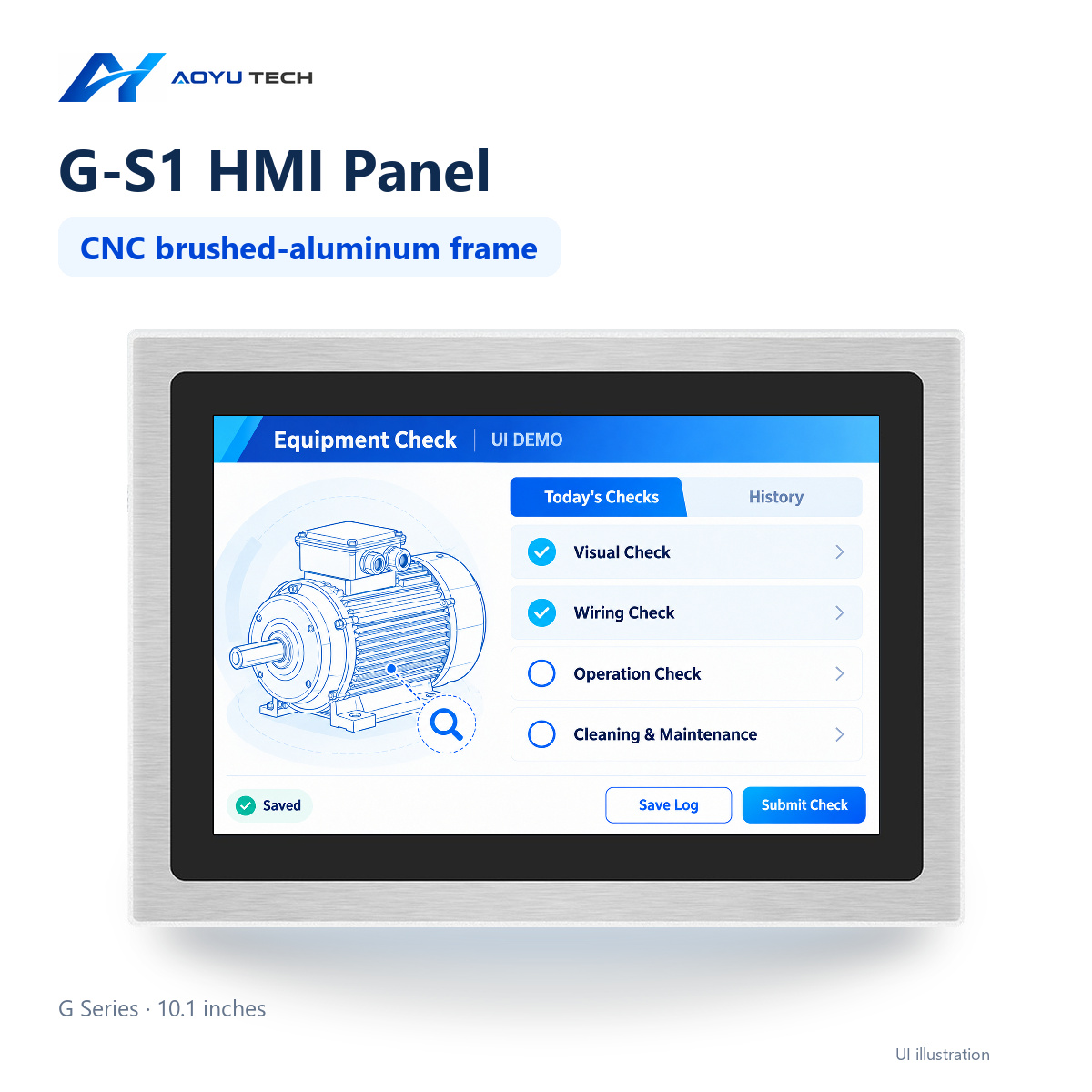
G-S1-101 10.1-inch HMI Panel
Series: G-S1. Frame: CNC aluminum alloy. Ethernet: 4 channels. Standard brightness: 500 cd…
View product →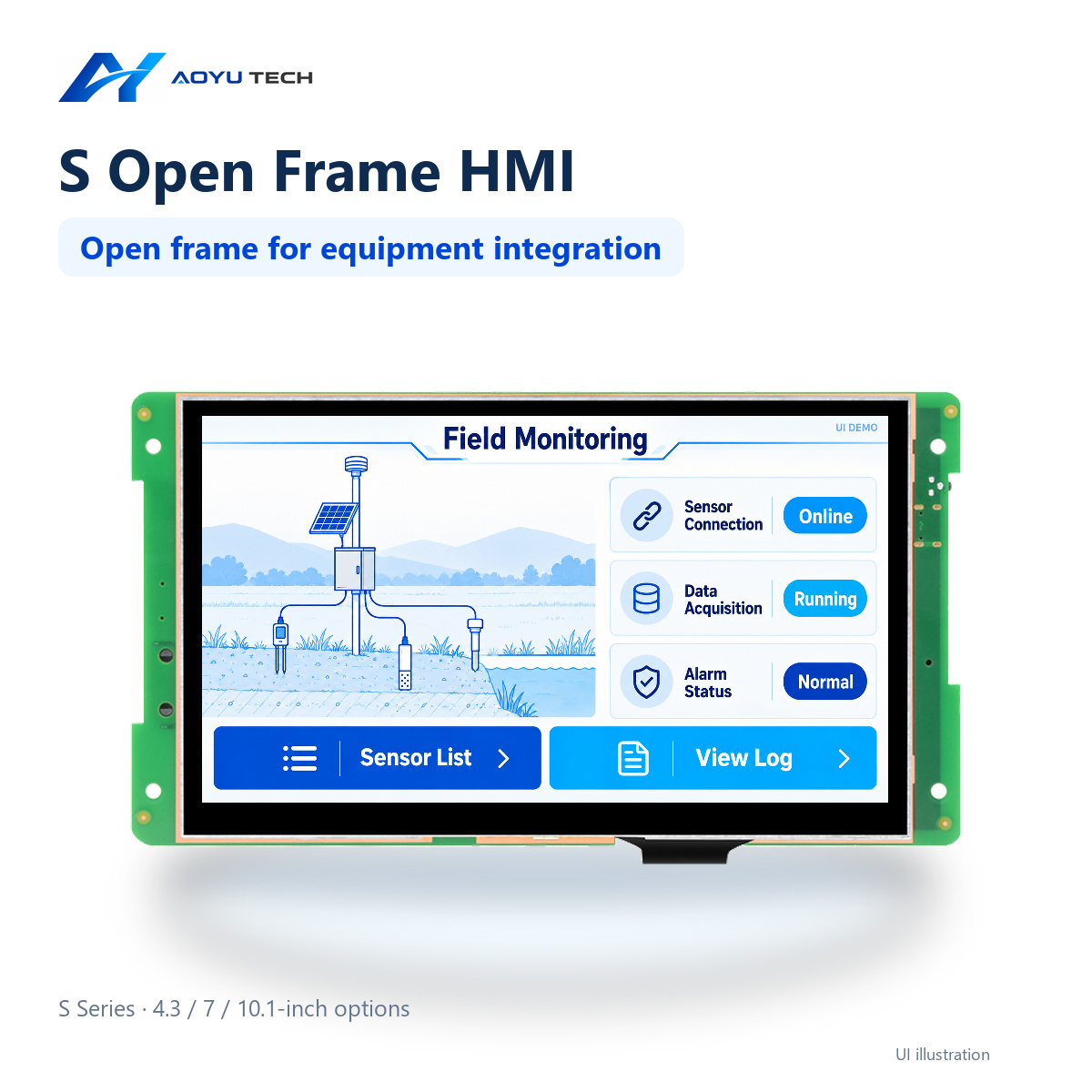
S-101 10.1-inch HMI Panel
Size: 10.1 inches. Resolution: 1024 × 600 px. Backlight brightness: 500 cd/m². Viewing ang…
View product →Ready to start your HMI project?
Our engineers help you choose the right HMI hardware and software for your project.